AvairAI Logo
Back to Resources
December 5, 2025•14 min read

AvairAI's Breakthrough TCPA Compliance System: One Click to Classify Every Phone Number as Safe or Risky

AvairAI's breakthrough TCPA compliance system classifies every phone number as safe or risky with one click. Avoid $500-$1,500 per call penalties. The only AI platform with built-in protection.

Deepak Singh
Deepak Singh
AvairAI's Breakthrough TCPA Compliance System: One Click to Classify Every Phone Number as Safe or Risky

Key Takeaways

  • TCPA violations cost $500-$1,500 per call—a 1,000-contact campaign with 10% bad numbers could mean $50,000-$150,000 in fines.
  • In 2025 alone, QuoteWizard settled for $19M, Kaiser for $10.5M, and Truist Bank for $4.1M—all legitimate companies with legal teams.
  • The B2B exemption is narrower than you think—calling mobile phones still requires consent, even for business contacts.
  • Over 55% of all US phone numbers (250M of 450M) are on the Do Not Call list.
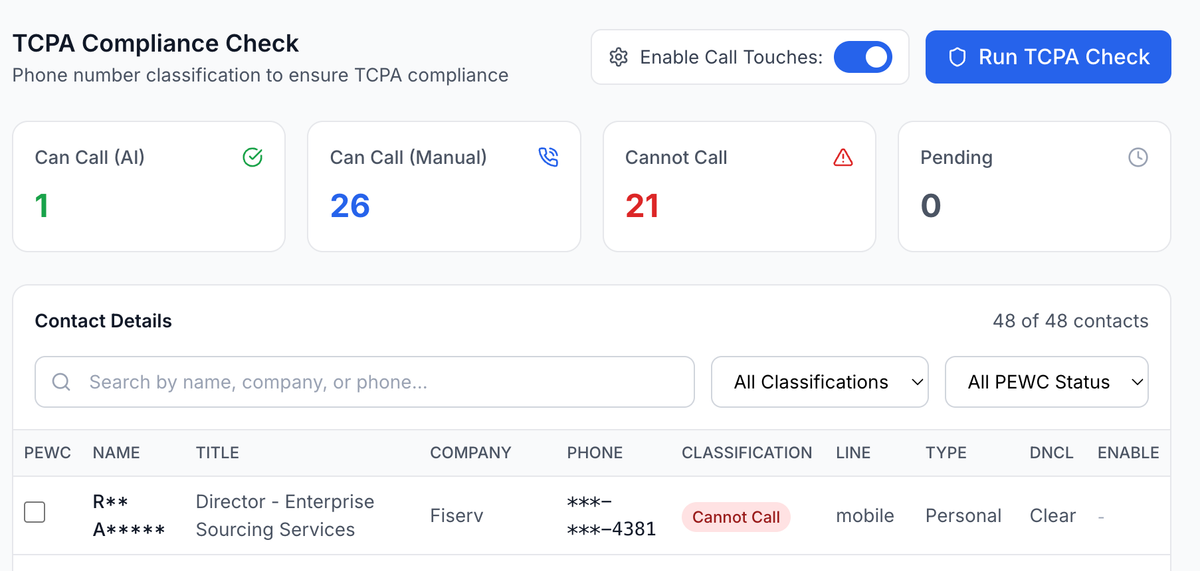
  • AvairAI's one-click TCPA check classifies every number as Green (safe for AI), Yellow (manual only), or Red (do not call).

The Telephone Consumer Protection Act (TCPA) is a federal law that restricts telemarketing calls, automated dialing systems (autodialers), prerecorded messages, and unsolicited faxes/texts to protect consumers from unwanted contact. Last week, QuoteWizard.com wrote a check for $19 million to settle a TCPA lawsuit. They thought they were just sending helpful text messages about insurance quotes.

They were wrong.

And here's the thing that keeps me up at night: they're not alone. Not even close.

This year alone, we've seen Kaiser Permanente settle for $10.5 million. Truist Bank for $4.1 million. Designer Brands for $4.42 million. The list goes on and on. We're not talking about shady telemarketing operations running spam schemes. We're talking about legitimate businesses with legal teams and compliance departments who still got it wrong.

Want to know what really worries me? These companies had way more resources than most of us do. And they still ended up writing eight-figure settlement checks.

So let me ask you something. Right now, today, if I looked at your contact database and randomly picked 100 phone numbers, how confident are you that calling those numbers wouldn't expose your company to devastating legal liability?

If you hesitated even for a second, keep reading. Because what I'm about to show you might save your business.

The TCPA Reality That Nobody Explains Properly

Here's what most people get wrong about the Telephone Consumer Protection Act. They think it's about preventing spam calls. You know, the ones about your car's extended warranty or a credit card you don't have.

That's not what TCPA is really about anymore.

TCPA has become one of the most aggressively enforced consumer protection laws in America. And it applies to pretty much every business that picks up a phone to call a customer or prospect.

Yes, even B2B companies. Yes, even if you have a "business relationship." Yes, even if the person gave you their number. Yes, even if you're just trying to help them.

The law is strict. I mean really strict. And the penalties? They'll make your eyes water.

$500 to $1,500 per violation. Not per campaign. Not per person. Per call. Or per text. Each one counts separately.

Let me put that in perspective for you. You've got a typical sales campaign with 1000 contacts. Pretty normal, right? Let's say 10% of those numbers are on the National Do Not Call Registry. That's actually a conservative estimate, but we'll go with it. That's 100 numbers you shouldn't call.

If you call each of them just once, you're looking at $50,000 to $150,000 in potential fines. From one campaign. One time through your list.

But wait, it gets worse. Much worse.

See, most sales campaigns don't stop at one call. You've got your follow-up sequence. Maybe you call three times, or five, or twelve. Each touch is a separate violation. That same campaign could expose you to $250,000 to $750,000 in liability.

And here's the kicker: if they can prove you knew about TCPA and called anyway? The penalties triple. We're now talking about $750,000 to $2.25M. From one campaign with 1000 contacts.

Still think this doesn't apply to you?

Actually, the percent of phone numbers on the do not call list is much higher than 10%. In the US, there are about 450M total phone lines (380M mobile and about 70M landlines). Of these, according to FCC, about 250M are in the do not call list, that is more than half phone numbers.

The problem is actually not just calling phone numbers that are on the do not call list. Calls to personal mobile numbers and residential landlines, without their prior written permission, can also trigger lawsuits.

The 2025 Lawsuit Parade

Let me show you just how real this is. These are actual settlements and penalties from 2025 alone:

  • QuoteWizard.com LLC: $19 million settlement over alleged spam texts
  • American Income Life Insurance: $14 million settlement for allegedly unsolicited sales calls
  • Kaiser Permanente: $10.5 million for text messages sent without proper consent
  • Zales Jewelers: $7.5 million+ for alleged unlawful marketing text messages
  • Albertsons Companies: $5.95 million for telemarketing calls and texts without prior express consent
  • Designer Brands and DSW: $4.42 million for unwanted marketing calls or texts
  • Truist Bank: $4.1 million for allegedly illegal prerecorded calls to consumers
  • NexGen Air Conditioning and Heating: $3.8 million+ for unsolicited prerecorded marketing messages
  • Fathom Realty: $2.8 million+ for texts to numbers on the National Do Not Call Registry
  • Western Express: $2.7 million+ for alleged robocalls sent without consent
  • Oregon Community Credit Union: $1.95 million for robocalls placed without consent
  • Colony Ridge Development: $1.9 million+ for unsolicited marketing text messages
  • UnitedHealth: $1.8 million+ for alleged use of prerecorded voice messages
  • Comodo Group: $1.625 million for prerecorded telemarketing calls without consent
  • Posh Group: $900,000 for allegedly unlawful marketing text messages

Notice anything about that list? These aren't small companies. They're not fly-by-night operations. They're banks, insurance companies, jewelry stores, credit unions, healthcare organizations. Companies with compliance officers and legal departments.

If they can get hit this hard, what makes you think you're safe?

And here's something else that should worry you: these are just the settlements that made the news. According to industry data, there are over 4,000 TCPA lawsuits filed every single year. Most of them settle quietly. Most of them never make headlines. But they're still writing big checks.

The B2B Myth That's Costing Companies Millions

I hear this all the time: "We do B2B sales, so TCPA doesn't apply to us."

I wish that were true. I really do.

Here's what actually happens. There IS a B2B exemption under the Telemarketing Sales Rule. It sounds great on paper. It says if you're calling to sell something to a business entity, you're generally exempt from the National Do Not Call Registry requirements.

But here's what they don't tell you in those compliance webinars.

First, the exemption is incredibly narrow. You're only protected if you're calling to sell to the business itself. The moment you're selling something for personal use to someone at their work number? That exemption disappears. Gone.

Second, and this is huge: the B2B exemption does NOT protect you from TCPA's consent requirements. If you're calling a mobile phone with an autodialer or prerecorded message (which includes AI-generated voices, by the way), you still need consent. Period. Doesn't matter if it's a business phone.

Third, about 25% of small and medium-sized businesses have their numbers registered on the National Do Not Call Registry anyway. Think about that. One in four of your "safe" B2B numbers might actually be landmines.

And fourth, here's the one that nobody sees coming: mixed-use phones. That business owner who gave you their cell number? They use it for personal stuff too. A federal appeals court recently ruled that if a phone number is on the DNC registry, it's presumptively residential. And guess what? The burden is on YOU to prove it's business-only.

Good luck with that.

Calling personal use cellular phone numbers for prospecting is not allowed and is inviting a lawsuit. Similarly, calling residential landlines is also fraught with risk. The B2B exemption literally only applies to landlines used by businesses and they are ok to be called.

So yeah, the B2B exemption exists. But it's like having an umbrella in a hurricane. Sure, technically you have protection. But you're still going to get soaked.

Why Traditional Approaches Leave You Exposed

"So I'll just check the DNC list manually," you're thinking.

Okay. Let's walk through what that actually looks like.

First, you need to subscribe to the National Do Not Call Registry. That'll cost you about $17,000 to $22,000 per year if you want nationwide coverage. Then you need to download the data every 31 days (that's the legal requirement). Then you need to export your contact list from your CRM. Then you need to... actually, you know what? I'm exhausted just typing this.

And here's the thing: even if you do all that, you're still not protected. Because the Do Not Call registry is just one piece of the puzzle. You also need to:

  • Check if numbers have been reassigned to new people (your consent doesn't transfer)
  • Identify whether each number is a mobile phone, landline, or VoIP (different rules apply)
  • Identify whether each number is for a personal or business line (different rules apply)
  • Screen for known TCPA litigators and complainers (yes, there are professional plaintiffs who make a living suing companies)
  • Track your own internal opt-out list
  • Verify consent status for AI calling
  • Ensure you're only calling during permitted hours in each person's timezone
  • Make sure your AI scripts include required disclosures

Oh, and you need to do all of this BEFORE every single campaign. And then keep doing it weekly while the campaign runs because DNC lists change constantly.

Some companies try using standalone TCPA compliance tools. And look, those tools have their place. But here's the problem: they're completely disconnected from your actual sales process. You have to export your list, upload it to the compliance tool, wait for results, download a CSV, then manually exclude the risky numbers.

And you'd better hope you didn't miss anything in that export-import shuffle. Because if you did? You're still liable.

Other companies just... cross their fingers and hope for the best. They figure if they're not intentionally doing anything wrong, they'll be fine.

That's not how TCPA works. It's strict liability. The law doesn't care about your intentions. It doesn't care that you didn't know. It doesn't care that you tried your best. You either complied or you didn't.

And then there are the companies that just stop calling altogether. They go all-in on email and LinkedIn. And watch their conversion rates drop off a cliff. Because here's the uncomfortable truth: the phone still works. It's still the fastest way to build real relationships and close deals. It's just terrifying now.

So what's the answer?

One Click Changes Everything

What if I told you that you could check every single number in your contact list for TCPA compliance with literally one click?

Not an export-import dance. Not a manual process. Not hoping you did it right.

One click. Complete protection. Built right into your campaign workflow.

That's what we built at Avair.ai. And honestly, I'm kind of amazed nobody else has done this yet.

Here's how it works, and I promise I'm going to keep this simple because the whole point is that you don't need to become a TCPA expert.

You're creating a campaign in AvairAI. You've set up your messaging, created your content, identified your target accounts, and built your contact list. You're ready to launch.

Before you hit that button, you click into the TCPA Compliance tab. Right there in your campaign. You don't leave the platform. You don't export anything.

You click "Run TCPA Check."

That's it. That's the whole thing.

Now, behind the scenes, something pretty sophisticated is happening. AvairAI uses proprietary AI technology that pulls insights from multiple different sources of data. We've spent months integrating and validating all of this so you don't have to. But you don't see any of that complexity. You just see a progress bar.

Within a few minutes (depending on how many contacts you have), you get your results.

And here's where it gets really elegant. Every single contact is classified into one of three categories:

🟢 CAN_CALL_AI - These numbers are safe for AI calling. We've verified they are ok to be called. We've checked your internal opt-out list. We've screened for known litigators. We've identified the line type and verified it's appropriate for AI calling. These are green lights. Call away with confidence.

🟡 CAN_CALL_MANUAL - These numbers have some complexity. Maybe the line type is uncertain, or there's a compliance nuance that requires human judgment. These contacts are flagged for your team to call manually. They show up in your Manual Tasks so your SDRs know to handle them personally.

đź”´ CANNOT_CALL - Don't touch these. Ever. These phone numbers may be mobile personal numbers, or on the do not call list, known litigators, numbers that have been reassigned, or contacts who've opted out. Avair automatically excludes them from your calling sequences. You can still reach them via email or LinkedIn, but the phone is off limits.

You see all of this in a simple, visual dashboard. Green. Yellow. Red.

Safe. Caution. Stop.

It's that clear.

What Makes This Different from Everything Else

I know what you're thinking. "Okay, but there are other compliance tools out there. What makes this special?"

Let me show you with a real comparison. This is what you have to do with traditional TCPA compliance tools versus what you do with Avair:

Traditional Compliance Tools:

Export your contact list from your CRM

Upload the file to a third-party compliance platform

Wait for the system to process your list

Log back in to check if it's done

Download the results as a CSV

Open the CSV and figure out what it means

Manually update your CRM with the classifications

Manually exclude risky numbers from your calling list

Hope you didn't make any mistakes in the transfer

Repeat this entire process every 30 days

And the cost? Typically $1,000 to $10,000 per month depending on volume. Plus your time. Plus the risk of human error in all those manual steps.

Avair:

Click "Run TCPA Check"

Review results

Launch campaign

Cost: Built into your AvairAI subscription. Time: A few minutes. Risk of error: Virtually zero because there's no manual export-import shuffle.

But here's what really sets AvairAI apart. It's not just about checking numbers before you call. It's about ongoing protection while your campaign is running.

Avair.ai automatically re-scrubs your active campaigns every week. Because do not call lists change. People opt out. Numbers get reassigned. With AvairAI, you're always protected, even as things change.

AvairAI automatically enforces business hours calling. The law says you can't call before 8 AM or after 9 PM in the recipient's local timezone. Do you really want to manually calculate timezones for every number in your list? Avair handles it automatically. If it's 10 PM in someone's timezone, Aviar will automatically not make the AI Agent call and will inform you not to make the manual call.

AvairAI automatically includes required disclosures in your AI-generated call scripts. Things like identifying that it's an AI agent, providing opt-out instructions, and stating your company name clearly. You don't have to remember what language is legally required. It's just built in.

Real Protection in Real Scenarios

Let me paint a picture of how this plays out in the real world.

Imagine you're launching your first AI calling campaign. You've got 500 contacts and of those 200 have phone numbers. You're excited about the technology, but you're also nervous about the legal risks. You've heard the horror stories.

You run the TCPA check in AvairAI. Here's what comes back:

  • 84 contacts are classified as CANNOT_CALL (42% of your list)
  • 72 contacts are classified as CAN_CALL_MANUAL (36% of your list)
  • 44 contacts are classified as CAN_CALL_AI (22% of your list)

You just avoided calling 84 people who would have been TCPA violations. At $500 to $1,500 per call, you just saved yourself $42,000 to $126,000 in potential fines. From one campaign. Before you made a single call.

The 36 manual-only contacts? Avair flags those for your human SDRs in the Manual Tasks dashboard. They can call those numbers personally, with the appropriate care and judgment.

The 22 green-light contacts? Your AI agents can call them with complete confidence. Every call is compliant. Every call is documented. Every call is legally defensible.

You launch the campaign. No anxiety. No sleepless nights. Just solid, compliant outreach.

Or here's another scenario. Your company just acquired a competitor. Part of the deal, you inherited their customer database. Twenty five thousand contacts. Sounds like gold, right?

But here's the problem: you have no idea what the compliance status of that database is. You don't know if they got proper consent. You don't know if they maintained an opt-out list. You don't know if half these numbers have been reassigned to new people.

What looks like a goldmine could actually be a minefield.

You import the entire database into Avair and run the TCPA check. The results are sobering:

  • 800 contacts are on the DNC Registry
  • 15 contacts are flagged as known TCPA litigators
  • 200 phone numbers have been reassigned to new people
  • 9000 phone numbers are personal mobile numbers
  • Various other compliance issues bring the total CANNOT_CALL list to 10,500.

You just identified over ten thousand lawsuit risks. If you had called all of them without checking, even just once, you could have been looking at $575,000 to $1.7 million in exposure.

Instead, you have a clean, compliant list of contacts you can safely reach out to. What could have been a liability just became a genuine asset.

One more scenario. You're a growing B2B SaaS company. You've found product-market fit, and now you need to scale. You want to 10x your outbound calling over the next quarter.

With traditional compliance approaches, scaling is terrifying. Every new contact is risk. Every new campaign is exposure. At some point, your legal team just says no. The risk is too high.

With AvairAI, compliance scales automatically. It doesn't matter if you're calling 100 people or 10,000 people. The protection is the same. The process is the same. One click. Green, yellow, red. Launch.

You can grow without fear. Your sales team can focus on selling instead of worrying about compliance. Your legal team can sleep at night. And you can actually hit those aggressive growth targets because you're not artificially limited by compliance fears.

It's Not Just About AI Calling

Here's something important that I need to make crystal clear. This isn't just about making AI calls safely.

This protects every call you make.

If you call someone on the DNC Registry, it doesn't matter whether an AI makes the call or your top SDR makes it personally. The violation is the same. The penalty is the same. $53,088 per call if it's intentional or you should have known better.

That's why AvairAI's classification system includes that yellow category: CAN_CALL_MANUAL. These are numbers that might be okay for a human to call with proper context and judgment, but aren't appropriate for automated AI calling.

Maybe the line type is slightly uncertain. Maybe there's a consent question that needs human verification. Maybe the person has a specific history with your company that an SDR should know about before picking up the phone.

AvairAI flags these for manual follow-up. Your team sees them in the Manual Tasks dashboard. They can review the context and decide how to proceed. They can make those calls personally, with the care and attention that situation requires.

The point is: whether you're using AI calling or not, you need to know which numbers are safe to dial. Avair tells you. Clearly. Definitively. Before you pick up the phone.

What This Means for Your Business

Let me bring this home with what actually matters to you.

First: you can grow without fear. You're not artificially limiting your outreach because you're terrified of TCPA. You're not leaving opportunity on the table because calling feels too risky. You can scale your campaigns, add new markets, increase your volume. All with the confidence that every call is compliant.

Second: your team becomes dramatically more efficient. No more exporting lists and importing results. No more manual spreadsheet gymnastics. No more meetings about which numbers are safe to call. Your sales team does what they do best: they sell. Avair handles compliance in the background, automatically, constantly.

Third: you have a genuine competitive advantage. Most of your competitors are in one of two camps. Either they've backed away from calling because they're scared (leaving money on the table), or they're flying blind and hoping nothing bad happens (taking massive risks they don't fully understand). You're in a third category: doing it right. That's a moat.

Fourth: you can actually sleep at night. No more wondering if that call you made yesterday is going to turn into a lawsuit tomorrow. No more anxiety about checking the mail. No more emergency meetings with legal counsel. You know you're protected. You have the documentation to prove it. You can focus on building your business instead of worrying about compliance.

Fifth: you protect your reputation. This isn't just about avoiding lawsuits. It's about avoiding BBB complaints, social media callouts, customer service nightmares. When someone opts out and you honor it immediately? When you don't call people who do not want to be called? When you respect their time and preferences? You're not just following the law. You're being a good company. That matters.

The Technical Part (Without Getting Technical)

I promised I'd keep this simple, so I'm not going to bore you with all the technical details of how this works under the hood. But I do want to address a question you're probably asking.

"How do I know this actually works? How do I know it's really protecting me?"

Fair question.

AvairAI's TCPA Compliance System is built on a multi-layered approach. We start with your internal opt-out list because that's free and instant. If someone has asked not to be called, we catch that immediately. No need to waste time or money checking anything else.

For contacts that pass the internal check, we leverage proprietary AI technology that pulls insights from multiple authoritative data sources. We're checking against:

  • Do not call registry (all 50 states plus federal)
  • Line type identification systems
  • Personal or business line identification
  • Number reassignment databases
  • Known litigator lists maintained by compliance experts
  • Phone intelligence services that verify line status and ownership

We merge all of this data intelligently. If there's any uncertainty, any gap in the data, any reason to question whether a number is safe? We err on the side of caution. That number gets classified as CANNOT_CALL or CAN_CALL_MANUAL.

And here's something important: according to telecommunications compliance experts, effective TCPA compliance requires checking multiple data points, not just the do not call registry. Line type matters. Reassignment history matters. Consent status matters. We check all of it.

The result? Classification accuracy above 95%. And when we're uncertain, we protect you by defaulting to the safer option.

Getting Started Is Absurdly Simple

Okay, you're convinced. You want this protection. What do you actually have to do?

If you're already using AvairAI for your campaigns, you already have it. It's built in. Just navigate to the TCPA Compliance tab in any campaign and click "Run TCPA Check." That's it.

If you're not using AvairAI yet, well, now you have another reason to consider it. Because this isn't a separate tool you have to buy and integrate. It's not an add-on that requires a new contract and a complex implementation. It's just part of how Avair works.

Create your campaign. Set up your messaging and targeting like you normally would. Load your contact list. Then click that TCPA check button. Review your results. Green, yellow, red. Make any adjustments you need to make. Launch with confidence.

The whole thing takes minutes. Not days. Not weeks. Minutes.

And once your campaign is running? The protection continues automatically. Weekly scrubs to catch any changes in DNC status or reassigned numbers. Business hours enforcement so you never call too early or too late. Real-time opt-out honoring so customer requests are respected immediately. Complete audit trails in case you ever need them.

You set it up once. It protects you continuously.

Frequently Asked Questions

Q: Does using AvairAI TCPA Compliance System guarantee I'll never get sued?

Let me be honest with you. No compliance tool on earth can absolutely guarantee you'll never face a TCPA claim. What we CAN do is dramatically reduce your risk by identifying and helping you avoid the most common violation triggers before you make calls.

More importantly, if you ever do face a challenge, having documented proof that you took reasonable compliance measures is powerful legal protection. Courts look favorably on companies that made good-faith efforts to comply. Avair provides that documentation automatically.

Think of it like cybersecurity. Having good security doesn't make hacking impossible, but it makes it much less likely and gives you much better standing if something does happen.

Q: What happens to the contacts classified as CANNOT_CALL? Can I still reach them?

Yes, absolutely. They're just excluded from your calling sequences, both AI and manual. You can still include them in email campaigns, LinkedIn outreach, direct mail, or any other channel. The classification only applies to phone calls.

Q: I'm a B2B company. Why do I need this if I'm exempt from most TCPA rules?

This is the most common misconception we see, and it's dangerous. Yes, there's a B2B exemption under the Telemarketing Sales Rule. But it's much narrower than most people think, and it doesn't protect you from TCPA's consent requirements.

If you're calling mobile phones, you need consent, period, even for B2B. Same applies to residential landlines. If those phones happen to be on the DNC registry (and about 25% of small business numbers are), you need to honor that. According to FCC, of the total of about 450M total phone numbers in the USA (both personal and business lines), about 250M (or 55%) are on the Do Not Call list. That is more than half of all phone numbers. If you're using AI calling or prerecorded messages, additional rules apply.

Plus, even if you're technically exempt from some rules, do you really want to call someone who's explicitly said they don't want telemarketing calls? The legal risk aside, it's just bad business practice.

Q: How often do I need to run the TCPA check?

You should run it before launching any new campaign. That's non-negotiable. That's your baseline protection.

After that, AvairAI handles ongoing compliance automatically. We re-scrub your active campaigns weekly to catch any changes to the phone number status. We enforce business hours in real-time. We honor opt-outs immediately.

Some customers like to run manual checks more frequently, especially for high-value campaigns or if they've added new contacts to a running campaign. You can do that anytime with one click. But the automatic weekly scrubbing means you're protected even if you forget.

Q: What if I already have consent for all my contacts? Do I still need this?

Yes, and here's why. Having consent is important, but it's not the only factor. Consent doesn't override DNC registration. If someone is on the National Do Not Call Registry, you generally can't call them even if they previously gave you consent.

Also, you still need to screen for known litigators, verify line types, check for number reassignments, and ensure you're not calling outside permitted hours. All of that happens in the TCPA check regardless of consent status. Litigators are known to have deliberately registered online and given consent for their DNC registered numbers and then have sued when those numbers were called.

Think of consent and DNC checking as two different but equally important layers of protection. You need both.

The Bottom Line

Look, I get it. TCPA compliance is complicated. It's scary. It feels like something that requires a law degree and a dedicated compliance team and a massive budget.

But here's what we've learned at AvairAI: compliance doesn't have to be hard. It just has to be built into the system from the beginning, not bolted on later as an afterthought.

Every year, thousands of legitimate businesses write checks for millions of dollars because they got TCPA wrong. Not because they're bad companies. Not because they're trying to spam people. Just because they didn't have the right tools to protect themselves.

You don't have to be one of them.

The phone is still the most powerful tool in sales. Real-time conversations. Objection handling. Relationship building. Closing. Nothing else comes close. But only if you can use it without risking everything.

Avair lets you use it. Safely. Confidently. At scale.

One click to classify every number as safe or risky. Green, Yellow, Red. That's it.

No exports. No imports. No compliance degree required. Just protection. Built in. Automatic. Complete.

Your competitors are either avoiding the phone (leaving opportunity on the table) or using it recklessly (taking massive risks). You can do better.

You can call with confidence. You can grow without fear. You can sleep at night.

AvairAI has invested significant resources in terms of time, effort, money and technology work to first fully understand all aspects of the TCPA regulations and related laws and then come up with a clever approach to automate this phone number classification with a click of a button. This is one of the “magic moments” that makes AvairAI and our lead-generation outreach technology the best solution in the market.

Ready to see which of your contacts are actually safe to call? Start your free trial or book a demo to see this in action.

Because here's the thing: every day you wait is another day of potential exposure. Another day of leaving revenue on the table because you're too scared to call. Another day of giving your competitors an advantage.

The solution exists. It's one click away.

What are you waiting for?

Deepak Singh

About Deepak Singh

Deepak Singh LinkedIn page.

Ready to transform your sales process?

Join forward-thinking sales teams already using the AvairAI platform.