How to Craft a Pair Selling Message That Gets Replies
Most AI outreach reads like a template. Pair Selling messages don't: AI handles the research and drafting, your rep adds what only a human knows, and the message gets answered.


Most sales teams have already bet on AI. Salesforce's State of Sales report found 81% of teams are either experimenting with it or have rolled it out fully. Yet the inbox tells a different story. Most AI-written outreach still reads like a template, and prospects delete it on sight.
The reason isn't the technology. It's how teams use it. Some hand the whole job to AI and ship messages no human ever read. Others refuse to automate and write every message by hand until the pipeline runs dry. Both miss the approach that works: a salesperson and AI splitting the job, each doing the part they're better at. That split is the core of the Pair Selling AI service from AvairAI, the AI sales prospecting platform for B2B sales. AI runs the prospecting grind; your reps add the relationship judgment that earns a reply.
This guide breaks down how to write Pair Selling messages that reach a few hundred of the right people without sounding like they came off an assembly line, and shows exactly where a human pass turns a decent draft into one a prospect answers.
Key takeaways
- AI and a human each take the part they're better at. AI researches and drafts at scale, your rep adds the context AI can't see, then AI runs the cadence and surfaces interested leads for your rep to book and close.
- Lead with the value the buyer gets, not your product. A message that opens on the prospect's situation gets read; one that opens on your platform gets deleted.
- The human pass should take 2 to 3 minutes per message, not 15. Rewrite every draft and you've lost the efficiency; send drafts untouched and you've skipped the human half of the job.
- From just your website, AvairAI drafts personalized multi-channel messaging in about 10 minutes and runs the 10-step, 2-to-3-week cadence, so your rep spends their hours on prospects who've already engaged.
Why most sales outreach falls flat
When you hand everything to AI
AI can generate thousands of personalized emails in minutes, and that is exactly the problem. Volume is easy to spot. Even with {FirstName} and {CompanyName} merged in, a message no human reviewed reads like it was sent to a list, because it was.
McKinsey's research on personalization found 71% of consumers expect personalized interactions and 76% get frustrated when they don't get them. But dropping a name and a company into a template isn't personalization, it's mail-merge. Real personalization shows the prospect you understand the problem they're sitting with this quarter.
Scale alone doesn't fix prospecting. Buyers already get more automated email than they can read, and the volume play makes you one more deletion. Cutting through takes the one thing AI can't manufacture on its own: a specific, human reason this message matters to this person right now.
When you refuse to automate
The opposite camp writes every message by hand and runs into a math problem it can't beat. Salesforce found that reps spend less than 30% of their time actually selling; the rest goes to research, admin and data entry. Hand-writing each message piles more onto the side of the ledger that isn't closing deals.
The ceiling here isn't quality, it's coverage. A strong rep might write 20 genuinely good messages in a day. The accounts worth reaching number in the hundreds. So they pick a handful, and every account they skip is pipeline left on the table. The goal isn't fewer messages or more, it's reaching 200 right contacts, not 20,000 random ones, and reaching all 200 well.
The three-step Pair Selling message framework
The Pair Selling service splits the work along a clean line: AI does the volume and the grind, the human does the judgment.
Step 1: AI researches and drafts
The first step starts with AI doing what it does best, processing a lot of information fast. It analyzes the company, the role, recent news, the tech stack and likely pain points, then drafts a first version with hooks specific to that contact, in variants for email, a call opening and LinkedIn. This is a real draft built on real data, not a blank template with fields to fill.
With AvairAI, the only input is your website. It scrapes your site, finds (or generates) the case-study insight that proves what you fix, then uses Pain-Signal Targeting to find the accounts showing public evidence of the problem you solve right now, and drafts personalized messaging for each. The whole build takes about 10 minutes, not the weeks a traditional setup runs.
Step 2: Your rep refines and personalizes
This is the step automation skips, and the reason Pair Selling works. The draft is a starting point. A salesperson adds what AI has no way to know: a mutual connection, a hallway conversation at last year's conference, a read on the buyer's style from how they post. They check that the value angle actually lands for this specific person.
Budget 2 to 3 minutes a message. In the 15 minutes it used to take to research and write one email from scratch, a rep now sharpens five AI drafts, five times the output at higher quality. The trick is spending human attention only where it changes the outcome, instead of burning it on research a machine already did.
Step 3: AI runs the cadence
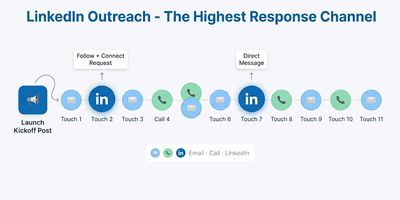
Once the messages are approved, AI takes execution off the rep's plate. It times sends, spaces follow-ups, watches for engagement and flags the moment a prospect leans in. The 10-step, 2-to-3-week cadence AvairAI runs across email, calls and LinkedIn would be impossible to keep straight by hand.
When a prospect replies with genuine interest, AvairAI surfaces them as an interested lead and hands them straight to the rep. This "hot handoff" means your rep spends the day on people who've already raised a hand, then books the meeting and closes, instead of dialing cold contacts who may never answer.
What a strong Pair Selling message looks like
Open with what's in it for them
The first line decides read or delete. Lead with the buyer's world, not your product, and reference a real challenge tied to their role, industry or a recent move.
Weak open: "I wanted to introduce myself and share how AvairAI helps companies like yours."
Strong open: "You just closed a Series B, which usually means adding pipeline faster than you can add SDRs. A few teams in that spot are doing it without growing the headcount, and here's how."
The strong version proves you noticed something specific (the raise) and speaks to the pressure that comes with it. The weak one makes the prospect do the work of figuring out why they should care.
Make the middle about them
The middle connects what you do to where they are. This is where the research pays off: reference the details that show you've done your homework, the tech stack, a recent announcement, a hiring pattern. Keep it tight. Cold emails tend to land best around 50 to 125 words, and a LinkedIn note has even less room. Cut any sentence that doesn't tie their situation to what you fix.
A good middle answers the question every prospect is silently asking: why are you contacting me specifically, and why should I care?
Ask for one small thing
End on a single, specific, low-friction ask. "Do you have 15 minutes Thursday afternoon?" beats "let me know if you'd like to learn more," which quietly hands the prospect a decision to make. Keep the first commitment small. A short call is easier to say yes to than an hour-long demo, and you can escalate once you're actually talking.
Adapting the message to each channel
Email, phone and LinkedIn each carry the same message differently, and a coordinated cadence across all three signals you're serious about the account in a way any single channel can't.
Email is still the primary B2B channel. Keep subject lines short, four to seven words, and personalized where you can. The body follows the structure above: value-first open, a middle about them, one clear ask. AI drafts the first version off the research, the rep adjusts tone and adds context, and AI handles sending and timing.
Phone
A call cuts through a crowded inbox. AI drafts the first 30 seconds and the objection responses off the same research that built the email, and the rep makes the call from a ready-to-run task, already briefed. AvairAI's AI Call Agent covers the secondary cases the law allows, testing a script, SDR and BDR practice, and compliant calls to warm or opted-in contacts. US TCPA rules keep automated calling off cold lists, so the rep owns the cold conversation, and the close.
LinkedIn messages run shorter still. AI researches the profile and drafts the connection note, the rep checks it reads like a person wrote it, and AI manages the follow-ups. LinkedIn earns its keep as part of the multi-channel cadence, not on its own.
Three mistakes that undo a good message
Sending drafts no one read
The most common failure is treating Pair Selling as "AI with occasional oversight." If drafts go out without a human pass, that isn't Pair Selling, it's automation with extra steps. Generic personalization, a name and a company and nothing else, fools no one. Prospects can tell when a message could have gone to anyone with their job title. The rep's pass exists precisely to add the specifics that prove you understand them.
Rewriting every draft from scratch
The opposite mistake is treating the AI draft as a rough idea you then completely redo. Spend 15 minutes editing each message and you've thrown away the efficiency that made the whole thing worth it. Aim for refinement, roughly 80% AI and 20% human judgment where it actually counts. If you're past 2 to 3 minutes per message, either the drafts need better inputs or you're overthinking it.
Talking about yourself
A message that opens with your product fails whether a human or an AI wrote it. "I wanted to tell you about our platform" loses the reader in seven words. Start in their world, their pressure, their recent move, and let your solution show up as the answer to a problem they already have, not the topic you walked in wanting to discuss.
Make Pair Selling messages your default
Pair Selling messages settle the old trade-off between reach and authenticity. AI does the research, the drafting and the execution; your rep adds the human read and confirms the value lands. Together they go out at the scale of automation and get answered like something a person actually wrote.
The framework is three steps:
- AI researches each prospect and drafts personalized messages for every channel.
- Your rep refines the tone and adds the relationship context AI can't see.
- AI runs the 10-step cadence and surfaces interested leads for the rep to book and close.
What you get back is more real conversations and fewer hours lost to the grind, with your salespeople spending their time on trust, discovery and closing. Start your first Pair Selling campaign with AvairAI: give it your website, and in about 10 minutes you'll have personalized, multi-channel messaging ready for your review. Refine the drafts, launch them, and let your reps do what only people can. You never sell alone.
← Back to all articles