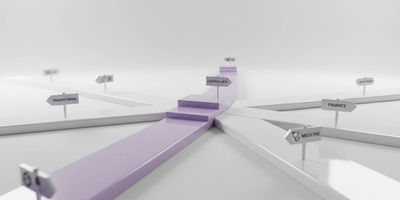
How AI Is Changing the SDR Role: From Dialer to Navigator
AI absorbs the prospecting grind so SDRs can do the strategic, relationship work that builds pipeline and careers.


Walk onto most sales floors today and the AI conversation has already moved past "if." The work is shifting under SDRs in real time, and the only open question is what it means for your career. The honest answer: AI is changing the SDR role from a volume job into a judgment job, and the reps who see that early are the ones getting promoted.
Start with the fear, because it deserves a straight answer. AI is not coming for the SDR seat. It is coming for the parts of the job nobody liked anyway, the list-building, the copy-paste research, the CRM hygiene, the 80th dial of the afternoon. What is left once those disappear is the work that actually develops a seller. This guide breaks down what is moving to AI, which skills are gaining value, and how to make yourself the person who guides deals rather than the one who just fills the top of the funnel. For the wider view, our complete guide to AI SDRs covers how the technology fits the whole pipeline.
The short version
- AI absorbs the grind, not the role. Research, list-building, first-draft outreach and follow-up timing move to software; the relationship and the judgment stay with you.
- The job is shifting from dialer to navigator: less raw activity, more guiding the right accounts through a real buying decision.
- The skills that earn a promotion are changing. Strategic account thinking and consultative conversations now matter more than your dial count ever did.
- This is how AvairAI's Pair Selling AI service works in practice. AI runs the repetitive work; you spend your hours where humans win.
What AI takes off your plate
Salesforce's State of Sales research keeps landing on the same uncomfortable number: reps spend less than a third of their time actually selling. The rest vanishes into admin, research and data entry. That is exactly the slice AI is built to reclaim, and it is reclaiming a lot of it. Gartner expects 60% of seller work to run through generative AI within five years, up from under 5% in 2023.
Here is where most of that lost time goes, and what AI now does instead:
- Research and list-building. AI scans databases, LinkedIn profiles, company news and Trigger Signals to assemble a targeted prospect list in minutes, work that used to eat whole mornings.
- First-draft outreach. It drafts the first-touch email and the call script from real research, so you edit and sharpen instead of staring at a blank page.
- Cadence execution. Email automation and AI-assisted calling keep a multi-touch campaign moving without anyone babysitting the calendar.
- CRM logging. Every reply and outcome lands in the system on its own. No more end-of-day data-entry marathon.
- Follow-up timing. AI tracks who replied, flags who is ready for another touch and sequences the cadence; you make the call when the moment is right.
Add it up and the trade is obvious. Work that used to take a skilled SDR most of a week, like standing up a precise campaign, now takes minutes, and those minutes come back to you.
What still belongs to a human
The tasks AI cannot fake are exactly where your value now concentrates.
Take qualification. AI can score basic fit: the industry, the headcount, the title, the funding round that just hit the news. What it cannot read is the nuance, who actually feels the pain, how urgent it really is, and the quiet politics that decide whether a deal moves at all. That judgment is yours, and it is the work that turns a name on a list into a real opportunity.
The same goes for relationships. AI can open a door; trust is what gets you through it, and trust is still built person to person. When a prospect throws an objection that is not in any script, or describes a situation that fits no pattern, a human adapts where a model stalls. And because AI surfaces more good opportunities than you can chase at once, deciding where to spend your limited hours becomes its own high-value skill.
From dialer to navigator
The shift runs deeper than task automation. It changes what the role is for.
The old SDR job rewarded volume. More dials, more emails, more touches. It was a grind, the burnout was real, and average tenure hovered around 14 months. The metrics measured activity rather than outcomes, and most of that activity was the very work AI now does better, which is a big part of why the traditional SDR model broke in the first place.
Pair Selling replaces that model with a partnership. AI handles the volume; the human navigates accounts through the buying process. A navigator SDR works a shorter list of real conversations, builds genuine expertise in an industry or a buyer persona, and feeds the AE hard intelligence on accounts they have personally developed. It looks a lot more like junior account management than telemarketing, and the navigator role in the Pair Selling service has its own playbook.
There is data behind the move. Gartner found that sales organizations giving reps AI-enabled next-best-action guidance are 2.6 times more likely to hit their growth targets. The edge comes from spending human attention on the few moments that actually move a deal, not from logging more activity.
The skills that gain value, and the ones that fade
The change here is concrete enough to plan your development around.
Gaining value:
- Strategic account thinking. With execution handled, your read on which accounts deserve focus and which angle will land becomes the job itself.
- Business acumen. Understanding how a prospect's company makes money, and where you fit their priorities, is what turns a pitch into a conversation worth having.
- Qualification judgment. Reading opportunity quality, mapping the real decision-makers and gauging how complex the buying process is. Sharper reads mean cleaner handoffs and higher close rates for your AE.
- Consultative conversation. Trading the scripted pitch for genuine discovery, the questions that surface a real problem instead of checking a box.
- Tool fluency. Not coding, just real comfort steering AI tools and reading the data they hand back.
Losing value:
- Pure call volume, now that AI handles first-touch.
- Manual research speed, now that the research compiles itself.
- Template writing, now that the first draft arrives personalized.
- Manual CRM discipline, now that the system captures most of it.
Across the board, the mechanical skills are fading while the analytical and relationship ones rise.
A day in the life, before and after
The clearest way to see the change is to put two days side by side.
The traditional SDR day:
- 8:00 a.m. Research prospects off an assigned list.
- 9:00 a.m. Call block, 50 dials against thin research.
- 11:00 a.m. Follow-up emails to yesterday's calls.
- 12:00 p.m. Lunch, usually working through it.
- 1:00 p.m. CRM data entry and activity logging.
- 2:00 p.m. Second call block, 50 more dials.
- 4:00 p.m. Build tomorrow's list.
- 5:00 p.m. Final CRM updates and email catch-up.
End of day: 100-plus activities, maybe 5 to 10 real conversations, and a steady diet of rejection. That is the grind that burns so many SDRs out.
The AI-augmented day:
- 8:00 a.m. Review AI-prioritized accounts and research summaries.
- 8:30 a.m. Plan the approach for each account that matters.
- 9:00 a.m. Calls to the interested prospects AI surfaced overnight.
- 10:00 a.m. A real discovery call with an engaged buyer.
- 10:45 a.m. Debrief the AE on a handoff.
- 11:00 a.m. Personalize AI-drafted messaging for key accounts.
- 12:00 p.m. Lunch, actually offline.
- 1:00 p.m. Follow-ups with warm prospects.
- 2:00 p.m. Multi-thread a target account.
- 3:00 p.m. Coaching session with your manager.
- 4:00 p.m. Pipeline review and prioritization.
- 5:00 p.m. Map tomorrow's strategic plays.
End of day: 20 to 30 conversations that mattered, several real opportunities, and energy left over. Same eight hours, almost none of it spent grinding.
Why this is the fastest path to AE
The navigator role is also the fastest route to a closing seat, and that should change how you feel about all of this.
The old way, you proved yourself with activity, and a promotion came from consistent dials and meetings booked. The catch was that the skills you built grinding the phones were not the skills the AE job needed. You walked into the next role half-prepared.
Navigator SDRs build the exact muscles an AE runs on: strategic thinking, consultative discovery and relationship-building. The work you do augmented by AI is, in miniature, the work an AE does, just earlier in the pipeline. It is the same shift AEs are making as they use AI to spend more time closing. Companies that promote from within notice the reps who already think like closers, and those reps move up sooner. For the step-by-step, we mapped the move from dialer to strategic seller.
The honest bottom line
AI is changing the SDR role whether you lean in or dig in, so the only real choice is which side of it you land on. Cling to the dialer model and you compete with software at the one thing software does better, raw volume. Step into the navigator role and your days fill with work that is more valuable, more interesting and far better for your career.
That split is what AvairAI's Pair Selling service is built for. AI runs the prospecting grind that hollowed out the old job; you take the strategy, the relationships and the judgment machines cannot touch and companies pay the most for.
Your job is not disappearing. It is turning into the better half of itself, and the SDRs who get that are not worried about AI. They are using it to build the career they actually wanted.
← Back to all articles