How to Build a Multi-Channel Lead Generation Engine
B2B buyers now reach suppliers across 10-plus channels. Here is how to build a lead generation engine that meets them on email, calls and LinkedIn.


Your buyers are not sitting in one inbox waiting for you. McKinsey's B2B research found that decision makers now reach suppliers across 10 or more channels during a single purchase, up from five in 2016, and 94% of them rate that omnichannel experience as effective. Reach them on one channel and, by definition, you miss most of the room.
That is the argument for a multi-channel lead generation engine: a coordinated system that works email, phone and LinkedIn together instead of betting everything on email alone. The problem is that building one the traditional way takes weeks of planning, a stack of tools that do not talk to each other and a budget most teams do not have. So most sales teams settle for whatever they can run by hand and wonder why the pipeline stays thin.
This guide lays out the faster path. You will get the five parts every multi-channel engine needs, how to time the channels so they reinforce each other, and how AI now compresses the setup from weeks to minutes without losing the coordination that makes the whole approach work.
Key takeaways
- Multi-channel matches how buyers actually buy. McKinsey finds B2B decision makers now use 10-plus channels per purchase, so single-channel outreach reaches only a fraction of them.
- Every engine has five parts: a sharp ICP, verified contact data, a coordinated email-calls-LinkedIn cadence, AI-plus-human execution and honest measurement. Miss one and performance leaks.
- AI compresses setup from weeks to minutes. With AI-powered lead generation, you go from your website to a live campaign in about 10 minutes.
- Phone is the channel most automated tools skip, and the one where your reps turn interest into booked meetings.
Why multi-channel beats single-channel
Multi-channel works because it matches how B2B purchases actually happen. McKinsey describes a rough rule of thirds: at any point in a deal, about a third of buyers want an in-person or video conversation, a third want a remote or phone touch, and a third would rather research on their own. Pick one channel and you serve, at best, a third of the people you are trying to reach. This is the norm now, not the edge; Salesforce's State of Sales reports that the average sales organization already sells across about 10 channels.
Preference also splits inside a single account. Picture a 60-person software company weighing your product. The VP of Sales takes calls between meetings but rarely opens an outreach email. The RevOps analyst running the actual evaluation lives on LinkedIn. The finance lead who signs the contract wants everything in writing, in the inbox, for the record. No single channel covers that committee. Three, timed well, can.
There is a timing problem too. Gartner found that B2B buyers spend only 17% of the buying journey meeting with all potential suppliers combined, and when they are comparing several vendors, any one rep may get 5% or 6% of their attention. You do not get many moments. Showing up on email, then LinkedIn, then by phone gives you more chances to land in one of the few windows a buyer is actually paying attention, and the repetition builds the familiarity that makes a later touch land instead of bounce. Coordinated multi-channel outreach compounds; isolated channels do not.
The five parts of a lead generation engine
Strip away the tooling and every effective engine comes down to five parts.
1. A sharp ideal customer profile
Everything downstream inherits the quality of your targeting. A vague ideal customer profile (ICP) produces vague outreach; a precise one is what makes real personalization possible in the first place. Define it on three layers. Firmographics, size, industry, geography and growth stage, decide whether a company can buy at all. Technographics, the stack they run and the competitors already inside the account, tell you what to say about switching and integration. Intent signals, active research, hiring spikes, funding rounds and renewal timing, tell you who is worth reaching this week instead of next quarter. Start from the customers you already win with and build your target account list from the patterns they share.
2. Verified contact data
Your engine runs on data, and bad data quietly wastes every other part of it. People change jobs, companies get acquired, the VP you sourced six months ago has moved on. The bar is not a syntactically valid email; it is a deliverable one attached to a person who still holds the role. This is where verification pays for itself: AvairAI's Contact Verification cuts bounce rates from about 30% to under 2%, which protects both your deliverability and your sender reputation. Clean data is the difference between a campaign that lands and one that burns your domain on bounces. Phone numbers need their own check, because whether a number is a mobile, landline or VoIP line changes how, and whether, you can legally dial it. Built-in TCPA compliance screens that before a single call goes out.
3. A coordinated email, calls and LinkedIn cadence
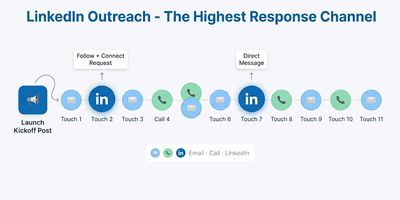
Channels reinforce each other only when they run as one cadence, not three separate campaigns. Each has a job. Email carries detail and creates a written trail, which is why it works for follow-ups and sharing resources. The phone is for trust and real-time objection handling, the channel where your reps turn mild interest into a booked meeting, and the one most automated tools quietly skip. LinkedIn warms a prospect before any direct pitch and re-engages the ones who went quiet elsewhere.
A workable cadence might open with a LinkedIn connection, move to a first email a day or two later, add a comment on the prospect's post, send a second email, then a call, a LinkedIn message and a final email, spread across about three weeks. AvairAI ships this as a pre-built 12-touch cadence, so you are not designing it from a blank page.
4. AI execution, human relationships
Running a 12-touch cadence by hand across dozens of contacts is the part that eats an SDR's week. AvairAI's Pair Selling AI service is built on this split. The AI does the volume work: researching each account, personalizing every message, sending the emails on a schedule that respects your domain limits, dropping contacts that bounce and sorting replies by sentiment so nothing slips. Your salespeople do the work only humans can: the calls, the LinkedIn conversations, the objection-handling and the close. AvairAI hands each rep ready-to-run call and LinkedIn tasks, each one carrying the contact, the script and the context, so their hours go to conversations instead of admin. AvairAI surfaces the interested leads; your reps book and close them.
5. Measurement that drives the next campaign
You cannot improve what you do not track. Watch reply rates by channel, because the mix that works in your market should reshape the cadence over time. Track the meetings your reps book per campaign, the number that actually ties to revenue. And watch pipeline velocity, how fast an engaged account moves from first touch to real opportunity. Multi-channel usually shortens it, and measuring the right things is how you prove it and tune it.
Building your engine, step by step
The five parts are the same whether you assemble them yourself or run them on a platform. What changes is how long each one takes to stand up.
- Define your ICP. Interview your best customers, study your closed-won deals and write down the firmographic, technographic and intent criteria they share. This is judgment work; do it yourself.
- Get verified contact data. Buy lists from several vendors and bolt on verification tools, or use a platform that already includes it. AvairAI gives you 105M+ verified contacts with employment verification built in, which removes the database-building step entirely.
- Lay out the cadence. Map which channel fires when. A 12-touch cadence over 3 weeks across email, calls and LinkedIn is a proven starting shape, and AvairAI ships it pre-built.
- Connect the execution. By hand, this means wiring together an email platform, a dialer, a LinkedIn tool and a CRM. AvairAI runs all of it from one place: it sends the emails and queues your reps' call and LinkedIn tasks automatically.
- Launch, measure, tune. Start the campaign, watch results by channel and adjust. These engines get better with every iteration as you learn what your market responds to.
The honest version of the old way is weeks of setup and a specialist to wire it together. With AvairAI, the only input is just your website, and you are live in about 10 minutes.
Where multi-channel engines go wrong
A few failure patterns repeat. The most common is defaulting back to email and treating phone as optional; even teams that call themselves multi-channel often leave the highest-trust channel unused, which is the same gap most automated outreach tools have. The second is inconsistent messaging, where the email, the call and the LinkedIn note tell three different stories and confuse the prospect instead of reinforcing one point. The third is chasing volume over fit. Reaching 200 right contacts beats a wide, random campaign to 20,000, every time, because relevance is the only outreach that still earns a reply.
Build your engine
Multi-channel lead generation works because it meets buyers where they already are, uses each channel for what it does best and shows up often enough to be remembered. The five parts do not change: a sharp ICP, verified data, a coordinated cadence, AI-plus-human execution and honest measurement. What has changed is the time and expertise it takes to get them running.
Done the traditional way, that is weeks of work and a pile of tools. Give AvairAI your website and it builds the targeting, the verified contacts and the pre-built 12-touch cadence, then runs the email while your reps handle the calls and LinkedIn from ready-to-run tasks. That is how AvairAI's Pair Selling service lets a small team run an enterprise-grade engine without adding headcount.
Start your first multi-channel campaign on a 14-day free trial, no credit card required. The AI runs the outreach; you book and close.
← Back to all articles